Look at the spec sheet below before you read a word of ours, because the whole
argument for the Steam Frame lives in it. Valve’s new headset shipped on 14
September, and the numbers tell a stranger, more interesting story than the
usual “new VR thing” headline.
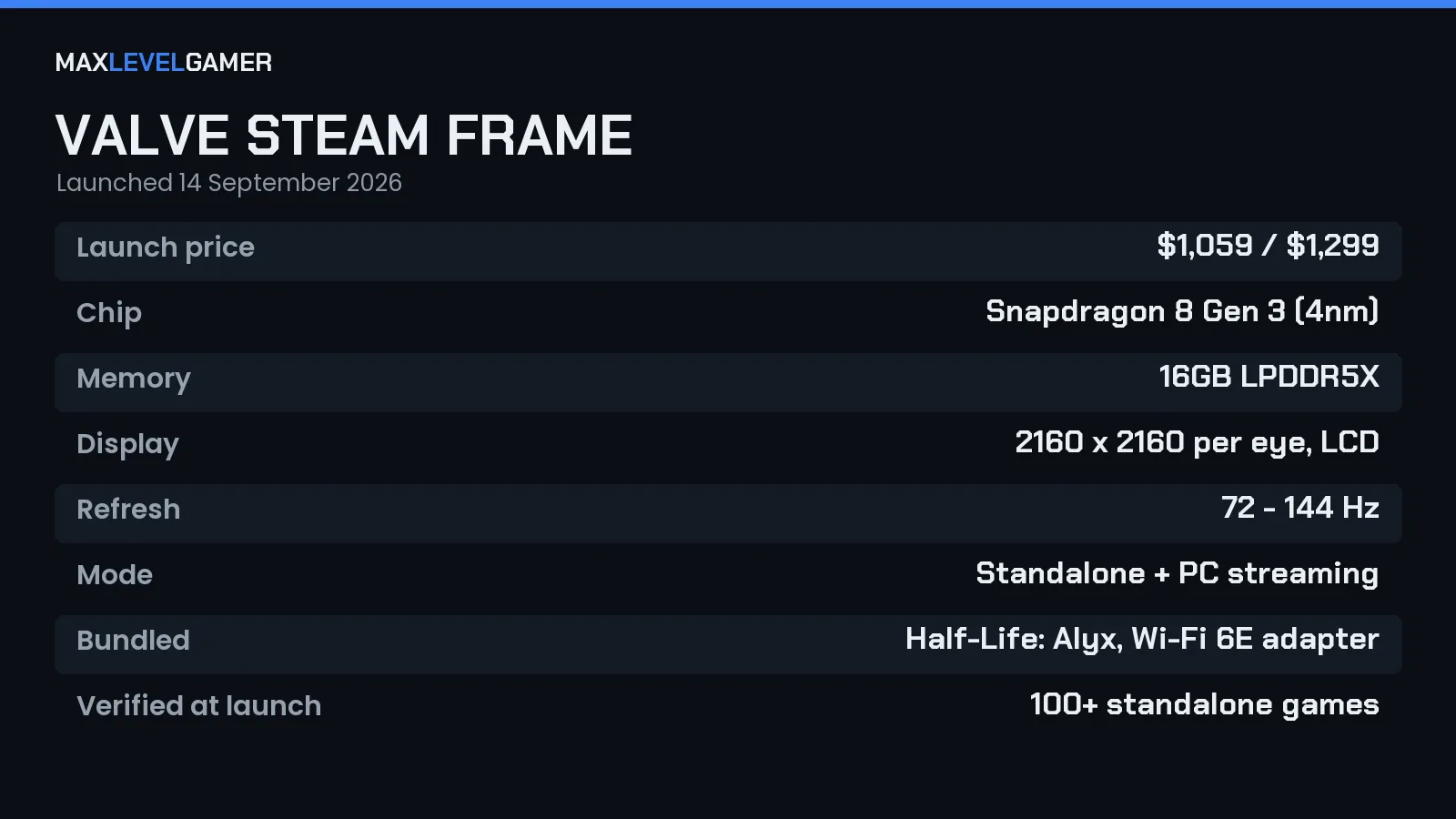
Here is what that sheet is quietly telling you. This is not a PC accessory
that dies when you unplug it. It is a standalone computer you strap to your
face, running SteamOS on a 4nm Snapdragon 8 Gen 3 with 16GB of LPDDR5X, and it
will either play games on its own or stream your big desktop rig over a
bundled Wi-Fi 6E adapter. That “or” is the entire product. Meta has been
selling that dream for years; Valve is selling it with your actual Steam
library on board, which for a lot of us is the only library that has ever
mattered.
So what does eleven hundred dollars actually buy?
Let us be honest about the price first, because it is not small. The 256GB
model is $1,059 and the 1TB jumps to $1,299, and then, in a move so Valve it
is almost funny, the power supply is a separate $29, which means you can spend
thirteen hundred dollars on a headset and still have to tick a box for the
plug, and somehow that tiny bit of cheek tells you more about Valve’s whole
personality than any launch trailer could, because this is a company that will
hand you a genuinely bleeding-edge piece of hardware and then charge you the
price of a sandwich for the cable that powers it, as if to remind you that
they do things their own way and you can either find it charming or go buy a
Quest. We find it charming. We are also aware that is precisely what they are
counting on.
Thirteen hundred dollars. Plus the plug.
But hold that next to the panel. Each eye gets a 2160×2160 LCD running
anywhere from 72 up to 144Hz, and that top refresh number is the one that made
us sit up, because high-frame VR is the difference between “impressive” and “I
can actually play this for an hour without my stomach filing a complaint.” The
Snapdragon doing the standalone lifting is the same class of chip in a
high-end phone, so nobody should expect it to run a maxed-out PC showpiece
untethered. That is what the streaming half is for.
Two computers. One face.
The library is the pitch
Valve says over 100 games are Steam Frame Standalone Verified at launch, which
is the headset equivalent of the Deck’s little green checkmark: a promise that
the thing will just work without you fiddling in menus for twenty minutes. And
crucially, the box comes with Half-Life: Alyx, still the best case anyone has
ever made for VR existing at all, so day one you have something genuinely
worth the faff of putting a computer on your head.
Steam is the moat
This is where Valve has an edge nobody else can buy. The Quest has a walled
storefront. The Steam Frame has Steam, the same account, the same wishlist,
the same sales you have been feeding since 2011. If the streaming is as clean
in a normal house, with a normal router, as Valve is implying, then the
fantasy is simple: sit on the sofa, stream your desktop’s ray-traced monster
of a game to a wireless headset, and never once think about a cable. We have
wanted that for a decade. We have also been burned by that promise for a
decade, so we are hopeful and squinting at the same time.
The catch, and it is the usual one
Wireless streaming lives and dies on your network, and no spec sheet on earth
can promise you a good time on bad Wi-Fi. The bundled 6E adapter is Valve
trying to control that variable, which is smart, but your walls, your
neighbours’ networks and your router’s age all get a vote. The standalone
chip, meanwhile, is plenty for lighter and older titles but is never going to
brute force a modern PC flagship on its own. So the honest framing is this:
the Steam Frame is two devices in one shell, and how much you love it depends
entirely on which of those two devices matches your living room.
Reservations ran through 17 September, and the early interest has been loud.
Whether the Steam Frame becomes the Deck of VR or another clever Valve thing
we admire from a distance comes down to that streaming experience in a
thousand messy real homes, not a lab. We will be strapping one on the moment
we can, and we will tell you the unvarnished version. Until then, the spec
sheet is the most honest pitch in the room, which is why we put it first.
(Specs via
Game Developer; if you are weighing a big PC purchase this year, our
GPU shortlist
is the companion read.)