You have been refreshing the same three retailer tabs since spring, waiting
for the number to drop. We get it. We did it too. And we are here, as the
people who sit next to you in the trenches, to gently take the mouse out of
your hand and tell you the truth: that number is not dropping. Not this
quarter, not next, and probably not before you finally cave and build on a
decade-old card that wheezes through the main menu of anything made after
2024. The waiting game had a logic to it once. Prices spiked, prices came back
down, patience got rewarded. That cycle is broken right now, and refusing to
believe it is costing you frames every single weekend.
So let us reframe the whole thing. The question is not “when will GPUs get
cheap again.” The question is “which card is actually worth buying at the ugly
prices in front of me today.” Those are completely different questions, and
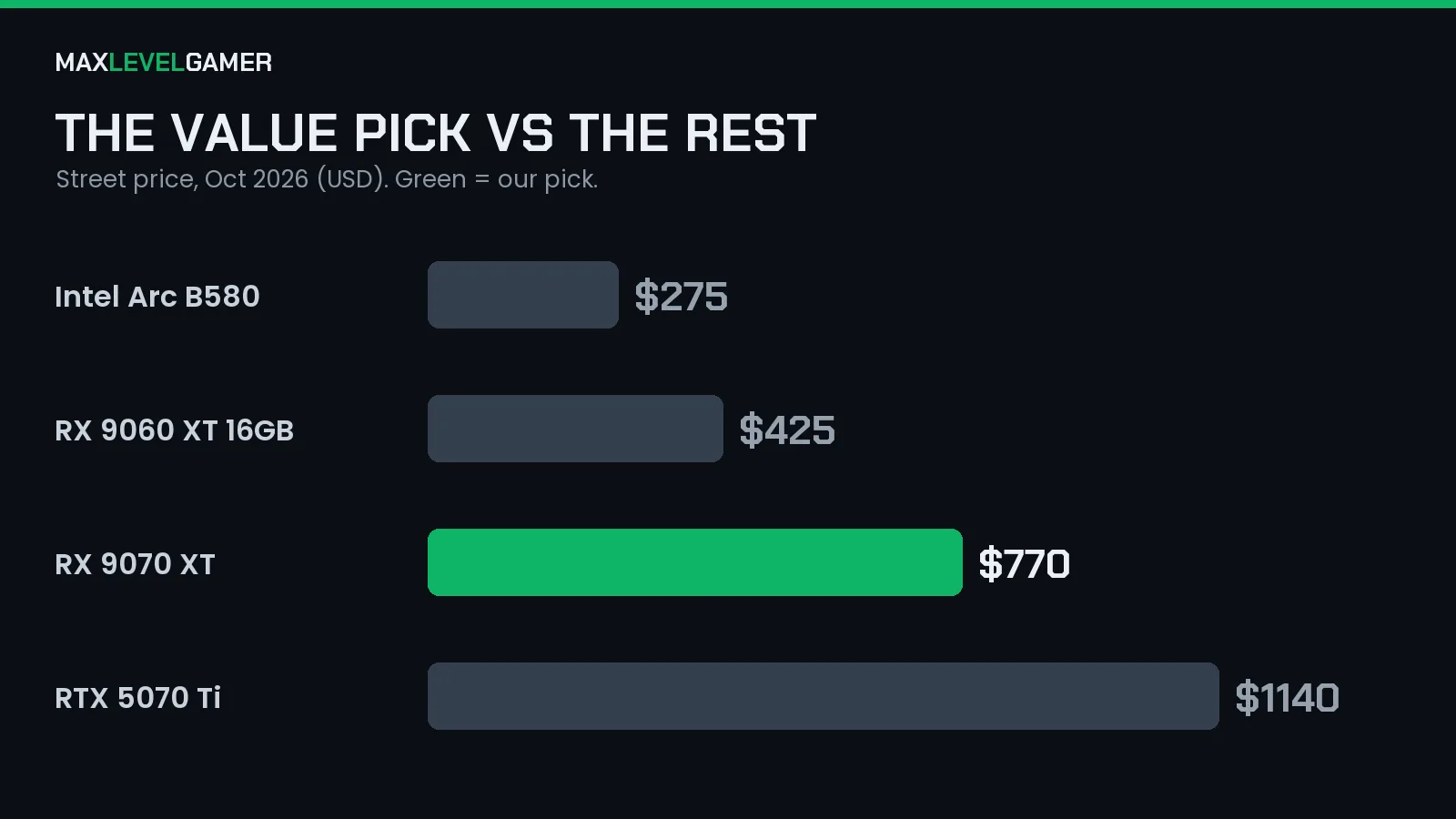
only one of them has an answer you can act on. The chart below lays out where
the money goes and where it quietly evaporates, because the gap between what a
card costs and what it gives you back has rarely been this lopsided.
Why is nobody’s “wait for the drop” working?
Because the thing squeezing prices is not scalpers or launch hype this time.
It is memory. The DRAM and GDDR shortage that has been chewing through the
whole market is forecast to run into 2028, and graphics cards are stuffed with
exactly the kind of memory that is in short supply. When the raw component is
scarce and expensive, the finished card does not get cheaper just because you
want it to. Board partners are not sitting on secret warehouses of cheap
silicon waiting for your patience to run out. They are paying more for memory,
and that cost lands on you.
We wrote about the memory crunch in more detail in
our RAM price piece, and the short version is bleak but clarifying: the pressure is structural,
not a blip. Waiting probably will not save you money. It will just cost you
the games you could have been playing.
The RX 9070 XT is the hero and it is not close
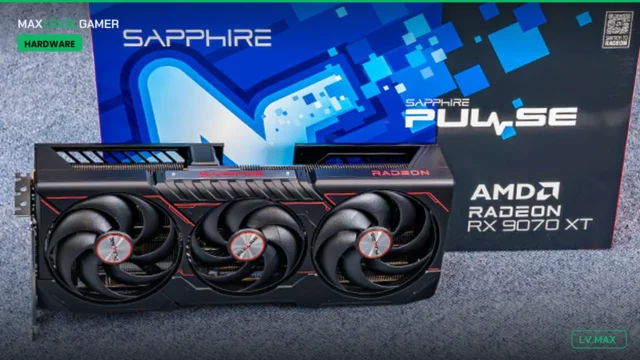
Here is where today gets interesting. As of October 2026, the Radeon RX 9070
XT is going for roughly $740 to $800 on the street. That is a chunky 23 to 33
percent over its $599 MSRP, and yes, that stings. Hold that feeling, because
it is about to look like a bargain.
The RTX 5070 Ti, its natural rival, is sitting at around $1,100 to $1,180.
That is 47 to 57 percent over its own MSRP. So the Nvidia card is not just a
bit pricier, it is roughly $300 to $400 more expensive in the real world. Now
the part that should make you put the credit card down and think: in raw
raster performance, the 5070 Ti is only about 2 percent faster at 1440p and
about 5 percent faster at 4K. Two percent. You cannot feel two percent. Nobody
has ever felt two percent.
Read that back. You would be paying somewhere near a three hundred dollar
premium for a performance difference you would need a frame counter and a
magnifying glass to notice. In pure rasterised gaming, the 9070 XT near $740
is the clear value pick, full stop. It is the card we keep pointing friends
toward when they ask, and it is the one sitting on our own shortlist of sane
buys over at
our GPU shortlist.
So when is Nvidia’s tax actually worth paying?
We are not here to be AMD cheerleaders. There are real, honest reasons to hand
Nvidia the extra money, and if any of these are you, the 5070 Ti stops looking
silly.
Pay the premium if you live in heavy ray tracing. Nvidia’s RT hardware still
pulls ahead when you crank path tracing in the games that lean on it, and if
that is the look you build your evenings around, that is a legitimate reason.
Pay it if you want DLSS 4 and its frame generation, which in the right titles
is genuinely lovely and smooths things in a way AMD’s answer has not fully
matched. And pay it, without hesitation, if you do CUDA or AI work on the
side. For local models, rendering, and anything that leans on the CUDA
ecosystem, the Nvidia card is not a luxury, it is the tool for the job and the
extra cost is a work expense.
Outside those three cases, though, you are buying a badge. And badges do not
render frames.
What if $740 is simply not happening?
Fair. Not everyone has that kind of money sitting around, and we are not going
to pretend otherwise. The good news is the lower tiers still hold up, and they
are where a lot of you should honestly be looking anyway.
For 1080p, the Intel Arc B580 at roughly $250 to $300 is still the little
champion it was when we first covered it. It punches well above its price for
sharp, high-refresh 1080p, and Intel’s drivers have come a long, long way from
the early mess. If you game on a 1080p monitor and have no plans to move up
soon, there is no shame here, only savings.
Step up to 1440p entry and the RX 9060 XT 16GB at around $400 to $450 is the
sensible landing spot. One firm piece of advice: get the 16GB version, not the
smaller one. The extra VRAM is the difference between a card that ages
gracefully and one that starts choking on texture settings in a year. Buy the
headroom. You will thank yourself.
What we’d actually buy
If we were spending our own money this week, we would buy the RX 9070 XT near
$740 and not look back. It is the best blend of price and real performance in
the stack right now, and it is the card we would build a rig around today
without flinching. If ray tracing, DLSS 4 frame generation, or CUDA and AI
work are genuinely part of your life, stretch to the RTX 5070 Ti and pay the
premium with a clear conscience, because then you are buying something you
will actually use. Tighter budget? The 9060 XT 16GB for 1440p or the Arc B580
for 1080p will get you gaming tonight instead of six months of “maybe next
sale.”
Stop waiting. The drop is not coming. The games are already here.