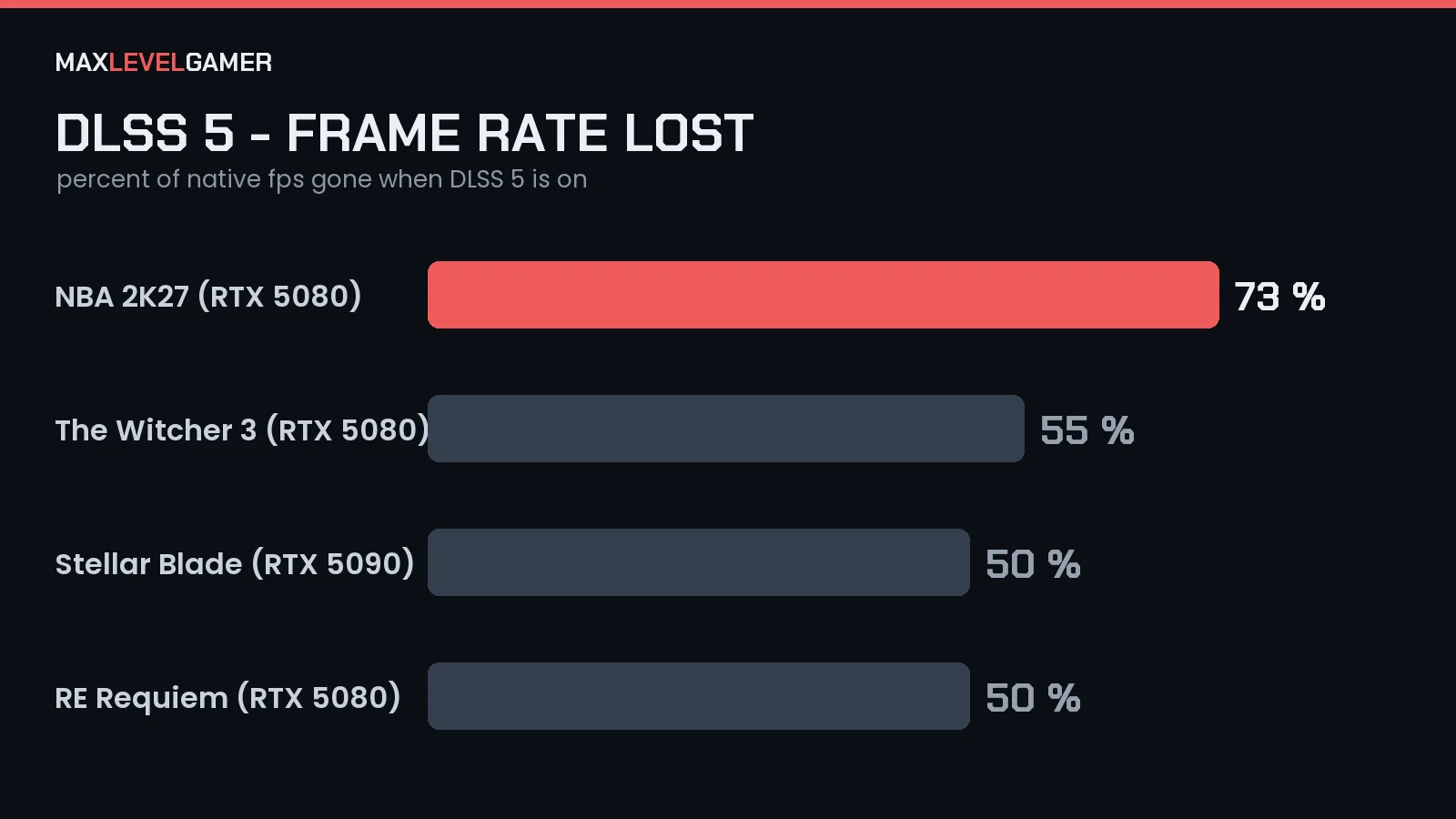
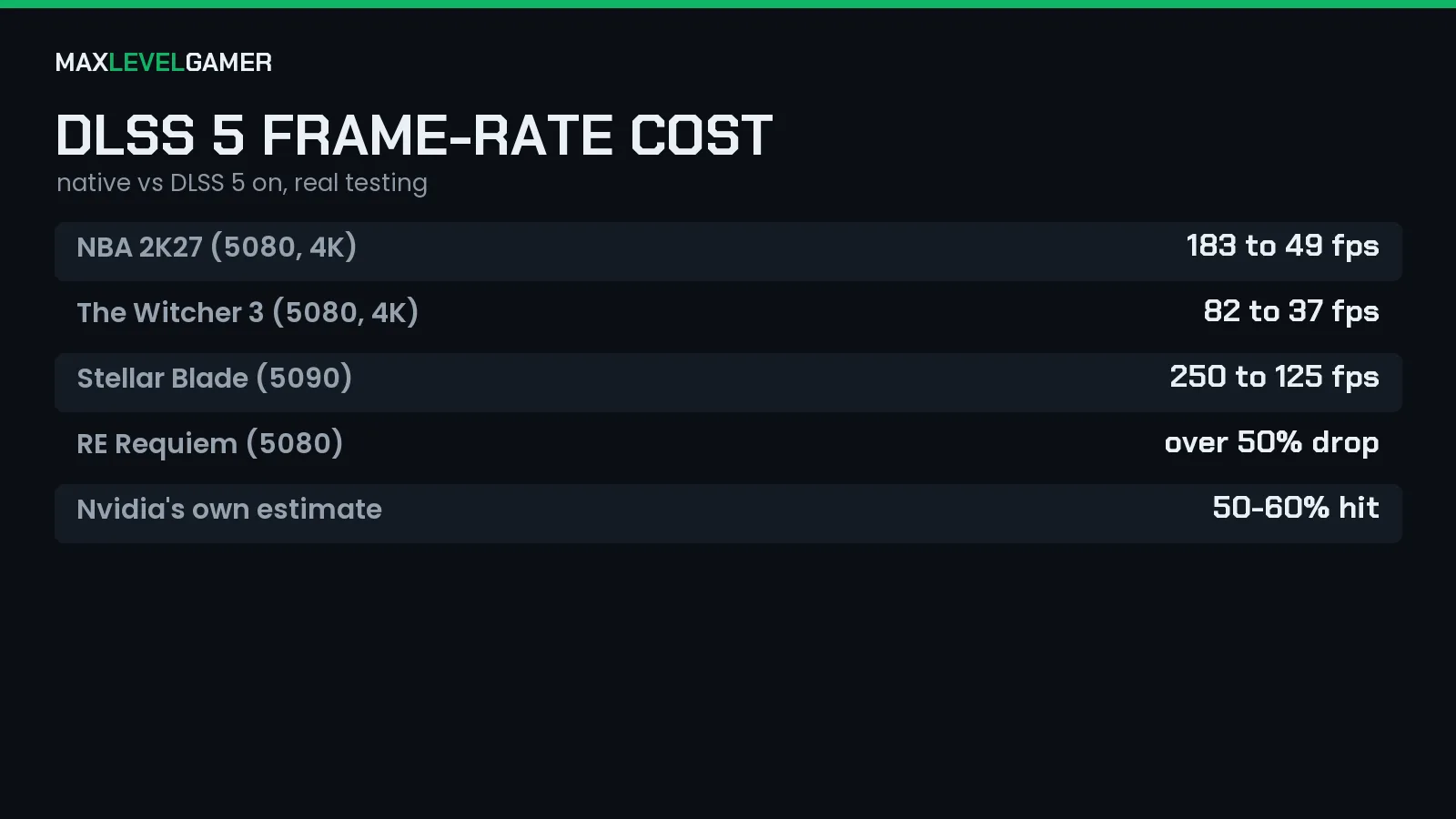
Start with the red bar, because it’s the one that made us put the coffee down. NBA 2K27, running on an RTX 5080, loses 73 percent of its native frame rate the moment you switch DLSS 5 on. Seventy-three. On an 80-class card that cost the thick end of a grand, in a basketball game, of all things. We read the number, assumed a typo, went and found the source, and no, that’s the number.
It isn’t a freak result either. Track the bars across and the pattern holds with a grim consistency: on TechSpot’s testing The Witcher 3 on that same 5080 gives up a little more than half its frames, Stellar Blade on a 5090 (the two-thousand-pound halo card, the one that’s meant to laugh at everything) gets sliced clean in half from 250 down to 125, and Resident Evil Requiem sheds north of 50 percent. Nvidia’s own pre-launch briefing had quietly floated a 50 to 60 percent hit, which is roughly the corporate way of whispering “you might want to sit down for this”, and it turned out that estimate was, if anything, a touch optimistic once independent testers actually plugged the cards in and hit record. That is the whole story of DLSS 5 in a single breath: a feature so heavy that even the company selling it lowballed how heavy it was, and the single fastest consumer graphics card on the planet still can’t run it without handing back half of everything it’s got, which rather undercuts the entire pitch that this is the technology carrying gaming gently into its next decade.
So then. The number you’ll actually see in the ads.
“Up to 370 fps with DLSS 5.” Sounds quick. Sounds like the opposite of every bar above.
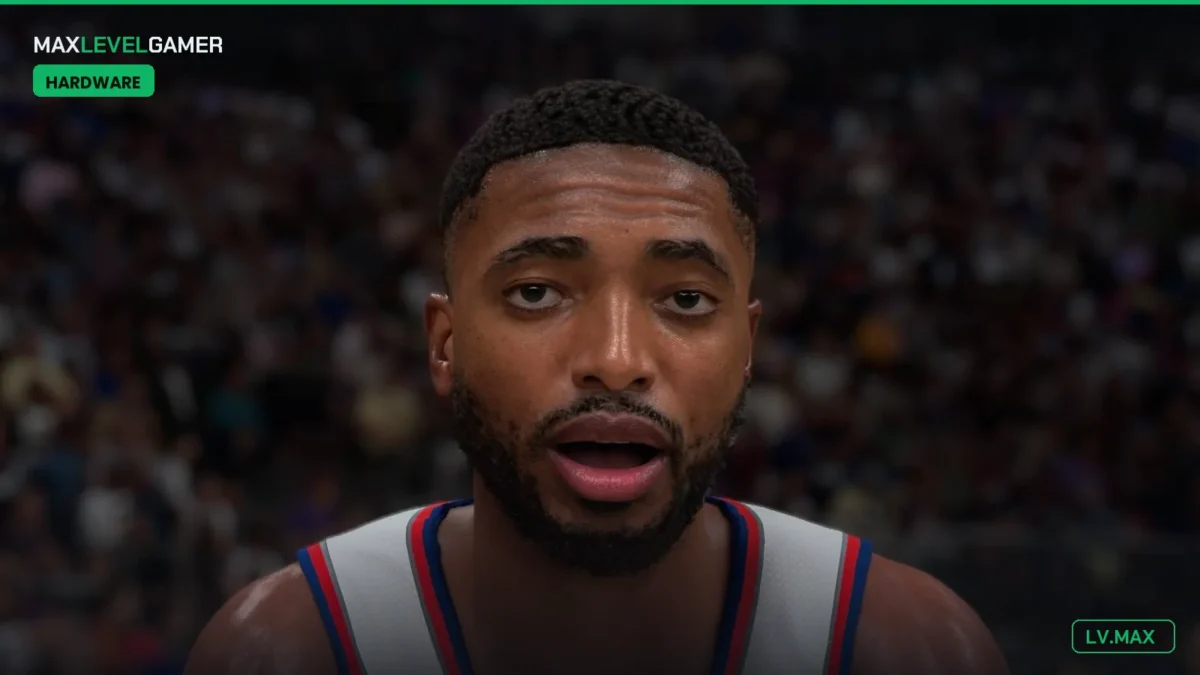
Here’s the sleight of hand. That 370 is frame generation doing the heavy lifting: the card renders somewhere around 39 real frames and the AI invents the rest, wedging fabricated frames in between the real ones so the counter reads like a dream. And to be fair, it does look like a dream. Motion is smoother, the picture is cleaner, the header shot at the top of this piece is a genuine DLSS 5 capture and it sits closer to a TV broadcast than to a video game. But frame generation smooths what you see, not what you feel. The input latency, that gap between your thumb moving and the screen answering, is still chained to those 39 real frames underneath. So you get a game that displays like a 120 fps machine and responds like a 39 fps one, and in a fast basketball game, or anything with a trigger, the half it left broken is exactly the half you cared about.
Thirty-nine real frames. Wearing a 120 frame badge.
Then Nvidia stepped square on its own rake. The company has already begun briefing that its next-generation RTX 60 cards will run DLSS 5 at a mere 10 to 15 percent cost, instead of the 30 to 50 you’re eating today. Wonderful news. If you happen to own a card that isn’t on sale yet. Slightly less wonderful if you took out a small loan for a 5090 last month on the specific promise that it was the future-proof pick, only to be told, in the very same breath, that the future runs this feature properly and your brand-new card simply does not. You paid top money to beta-test the thing for the people patient enough to wait.
We’re not here to call DLSS 5 a con. The image quality is real, the neural rendering is genuinely clever, and in a slow single-player game where latency barely registers it might even be a fair trade you’d happily make. But “up to 370 fps” is a number engineered to be screenshotted, not felt, and the honest figure, the one that never makes it onto a slide, is what 39 real frames feel like under a full 4K neural render on a three-thousand-pound PC.
Our read: leave it switched off until the cards that can actually afford it turn up. If you want the deeper mechanics, the DLSS 5 explainer pulls it all apart, and the 2026 GPU value guide is worth a read before you spend a single penny chasing that headline.